
Hangul Day: King Sejong's Alphabet and How Seoul Celebrates It
Hangul Day, held every October 9, is the Korean national holiday that celebrates Hangul, the alphabet King Sejong created in 1443 and promulgated in 1446 so that ordinary people could read and write their own language. Its 24 letters are built from simple strokes that mirror how sounds are made in the mouth, which is why many learners can read it within days. In Seoul, the day is marked at Gwanghwamun Square around the King Sejong statue, with exhibitions and hands-on events nearby.

King Sejong and the Birth of Hangul
For most of Korean history, writing meant Classical Chinese. Educated men spent years memorizing thousands of characters, and everyone else, including most women, farmers and merchants, had no practical way to put their own spoken language on paper. Some workarounds existed, such as systems that borrowed Chinese characters for their sound, but they were clumsy and still demanded a scholar's training.
King Sejong, the fourth ruler of the Joseon dynasty, set out to change that. He completed a new set of letters in 1443 and formally announced it in 1446 in a document called Hunminjeongeum, which translates as "the correct sounds for instructing the people." The name tells you the purpose. In his short preface, Sejong writes that the speech of his country differs from that of China, that its people often cannot express what they want to say in borrowed characters, and that he has therefore made twenty-eight letters he hopes everyone can learn easily and use in daily life.
The project met resistance. A group of court scholars submitted a well-known memorial objecting that a native script would set Korea apart from the shared Chinese-character world and weaken classical learning. Sejong pressed ahead, and the alphabet went to work almost immediately: within a year of the announcement, the court was printing songs and Buddhist texts in the new letters.
What survives of that moment is remarkable. The explanatory edition of the text, the Hunminjeongeum Haerye, was compiled by scholars of Sejong's Hall of Worthies and lays out exactly how the letters were designed. A copy was found in 1940 in an old house in Andong, is now held by the Kansong Art Museum in Seoul, and was inscribed on UNESCO's Memory of the World Register in 1997. Few writing systems come with their inventor's own design notes.

Why Is Hangul Easy to Learn?
Ask anyone who has tried it and you will hear a version of the same story: they sat down with a chart on the flight to Seoul and could sound out café menus by the time they landed. That is not a marketing line. It follows from how the alphabet was designed, and the Haerye itself makes the claim. In his afterword, the scholar Jeong In-ji wrote that a clever person could master the letters before a morning was over, and even a slow learner within ten days.
Three design choices do most of the work.
The consonants are drawings of the mouth. The five basic consonant shapes were modeled on the speech organs that produce them. ㄱ (g/k) shows the back of the tongue rising to block the throat; ㄴ (n) shows the tongue tip touching the ridge behind the upper teeth; ㅁ (m) is the outline of closed lips; ㅅ (s) represents a tooth; ㅇ is the round opening of the throat. Related sounds are made by adding strokes, so ㄱ becomes ㅋ (a breathier k) and ㄴ grows into ㄷ and ㅌ. Learn the base shape and you already have a clue to its family. Linguists sometimes call this a featural writing system, because the shapes encode features of pronunciation rather than standing as arbitrary symbols.
The vowels come from three strokes. A dot for heaven, a horizontal line for earth and a vertical line for a person were combined to form every vowel. In modern print the dot has become a short tick, so ㅏ, ㅓ, ㅗ and ㅜ are simply a long line with a short stroke placed on one side or the other.
Letters stack into syllable blocks. Instead of running in a long line, letters are grouped into square blocks of one syllable each: 한 is ㅎ + ㅏ + ㄴ, and 글 is ㄱ + ㅡ + ㄹ. Put them side by side and you have 한글. Today the alphabet uses 24 basic letters, 14 consonants and 10 vowels, after four of Sejong's original 28 fell out of use.
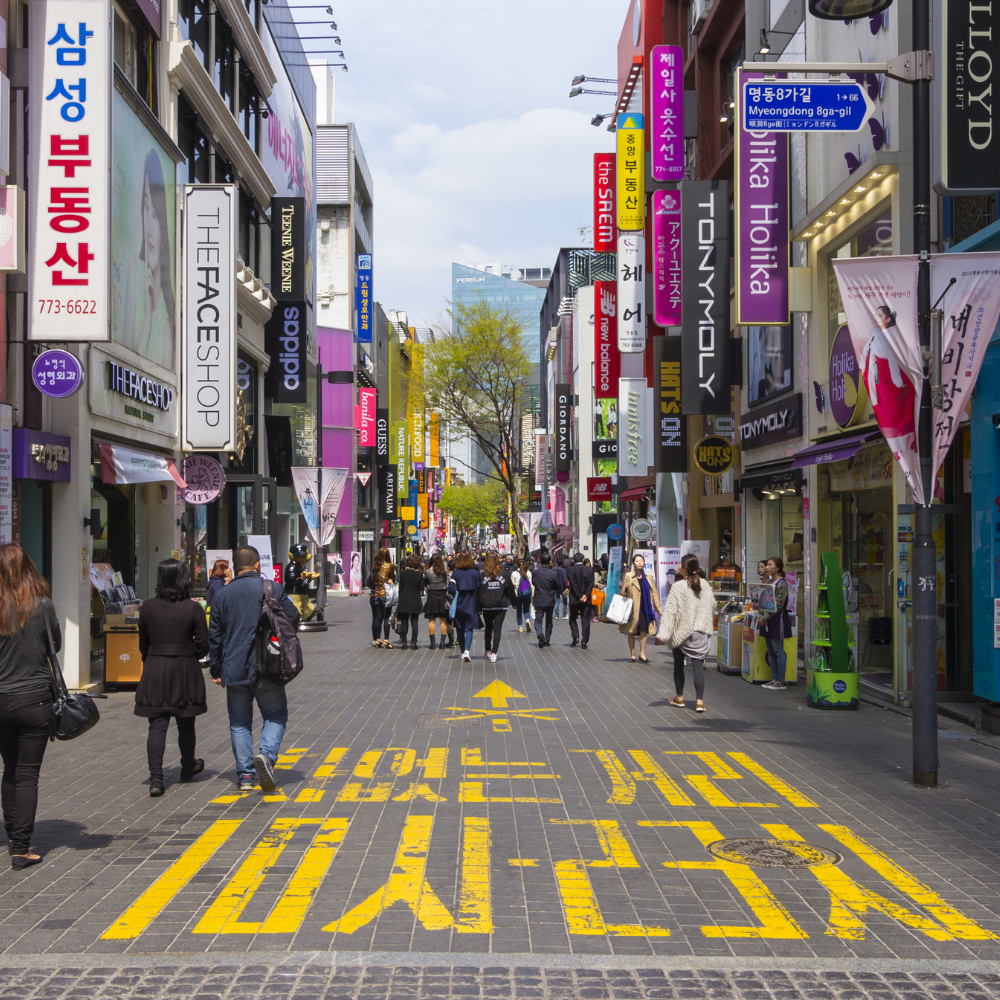
None of this means Korean the language is quick to master. Grammar, honorifics and vocabulary take real time. But reading the script is a weekend project, and it changes a trip immediately. Signs, subway stops and menus stop being decoration and start being words, many of them English loanwords in disguise. Pair the letters with a handful of essential Korean phrases for travelers and you will be surprised how far you get.

From Gagyanal to Hangul Day: A Holiday Turns 100
Hangul Day is younger than the alphabet by almost five centuries. In 1926, under Japanese colonial rule, the Korean Language Research Society held the first celebration of the script and called it Gagyanal, after "ga-gya," the opening sounds of the syllable charts that children once used to learn to read. Marking the day was a quiet act of cultural self-preservation at a time when the Korean language was under growing pressure. The name changed to Hangeullal two years later.
The date moved too. Early celebrations followed the lunar calendar, until researchers settled on October 9, based on the date recorded in the Haerye, which the text places in the first days of the ninth lunar month of 1446. That date has been used since 1945. After liberation, Hangul Day became a public holiday in 1949, was dropped from the list of days off in the early 1990s, was raised to the status of a national day in 2005 and was restored as a public holiday in 2012.
That history is why this year carries extra weight. It marks 100 years since that first Gagyanal and 580 years since Sejong's promulgation. The National Hangeul Museum has declared it the Year of Hangul, and it is also the centenary of Hunmaengjeongeum, the Korean braille system published in 1926.
The clearest way to see that century is a new joint exhibition marking the anniversary, opening on October 2 on the third floor of the National Museum of Korean Contemporary History on Sejong-daero, a short walk from the King Sejong statue. Organized by the National Hangeul Museum with the history museum, the Hangul Society and the King Sejong the Great Memorial Society, it traces how Gagyanal became Hangul Day and how the very word "Hangul" came into use.

How to Celebrate Hangul Day in Seoul
This year Hangul Day falls on Friday, October 9, which gives Seoul a three-day weekend. Expect busier palaces and a festive mood around Gwanghwamun, and plan accordingly. Here is how to spend it, based on what the official organizers have announced.
Start at the King Sejong statue. The gilded seated figure in Gwanghwamun Square is the natural focal point of the day, and official commemorations and flower offerings traditionally gather here. Behind the statue, steps lead down to Sejong Story, a free exhibition hall under the square that walks through Sejong's life, his science and music projects, and the creation of Hangul. It is closed on Mondays, so a Friday holiday visit works well.
Join the Hangul Hanmadang at Gwanghwamun, October 6 to 8. According to the National Hangeul Museum, its Hangul festival runs from noon to 8 p.m. on those three days in the square's Nolimadang area. Activities include printing lines of Hunminjeongeum on a letterpress, decorating a light-up Hangul lamp, making a mother-of-pearl norigae ornament from Hangul letters, painting a tote bag with Hangul patterns, and digital games such as a spelling challenge and an AI King Sejong who answers questions about why he made the alphabet. A fair of Hangul-themed design goods also runs at Gwanghwamun during the same days.
Spend October 9 itself at the National Museum of Korea. On the holiday, the museum's Hangul program moves to the outdoor plaza in front of the Geoulmot pond at the National Museum of Korea in Yongsan, from noon to 6 p.m., with a selection of the same hands-on activities. Combine it with the museum's permanent galleries for a full afternoon. The National Hangeul Museum's own building next door is closed for rebuilding work, with reopening planned for 2028, which is why its programs are out in the city this year.
See the centenary exhibition. The Gagyanal-to-Hangul Day exhibition at the National Museum of Korean Contemporary History opens on October 2, so it fits neatly into a Gwanghwamun day alongside the statue and Sejong Story.
Pick up a brush. If you want to take something home that you made, a calligraphy session is the most direct way to feel how these letters were meant to be written. Several studios offer short classes, covered in our guide to traditional Korean craft classes in Seoul, and the shops of Insadong sell brushes, ink and hanji paper if you would rather practice on your own.
Event programs can change, so check the National Hangeul Museum's website or social channels for the latest schedule before you go.

Dr. Beau's Note
Here is a small, practical reason to learn Hangul before a beauty trip: a surprising share of Korean skincare vocabulary is borrowed English written in Korean letters. 세럼 is serum, 토너 is toner, 크림 is cream, 선크림 is sunscreen. Once you can sound out a label, the front of a bottle stops being a mystery and you can match it to the ingredient list you already understand.
It also makes conversations at a pharmacy counter or clinic reception noticeably easier, because you can point to a word and pronounce it. If something on a label still raises a question about your own skin, that is a conversation to have with a qualified professional rather than a translation app.