
Busan's Coastal Beauty: Where the Sea Meets Korean Soul
Busan's coast divides its labour cleanly: Haeundae is the grand public beach with the sky-capsule coastal train running above it, Gwangalli is the night beach where the bridge lights up and weekly drone shows draw the crowds, Songjeong is where Korea learned to surf, and the cliff paths between them — temple on the rocks at Yonggungsa, painted lanes at Huinnyeoul — are where the coast stops being a beach and becomes a place. Two and a half hours from Seoul by KTX, and worth an overnight far more than a day.

Why Busan's Beaches Are More Than Just Sand
Busan is the rare big city built genuinely into its coastline rather than beside it — hills pushing neighbourhoods down to the waterline, subway stations a five-minute walk from sand, fish markets and cliff temples and high-rise skylines sharing single photographs. The result is a beach culture with an urban rhythm: locals jog the boardwalks before work, office workers eat raw fish with sea views at lunch, and the beaches fill again after dark, in every season, because they function as the city's shared front yard rather than a summer resort.
For a visitor, that changes what a "beach day" means here. Swimming is a two-month summer affair, but the coast itself works year-round — the walks, the cafes hanging over the water, the temple on the rocks, the night bridge. Nobody comes to Busan's coast just to lie down. It is Korea's most complete seaside city, and it rewards being treated like one.
Haeundae vs. Gwangalli: Which Beach Should You Choose?
The honest answer is both, in the correct order — because they run on different clocks.
Haeundae is the day beach. Korea's most famous stretch of sand: broad, event-filled, backed by hotel towers, with the full apparatus of a great public beach in summer — umbrella grids to the horizon, festivals, saunas and the aquarium behind. Its modern trump card is the Blueline Park coastal railway: the slow beach train and the elevated sky-capsule cars running the clifftop line from Mipo past Cheongsapo's lighthouses to Songjeong, turning the prettiest stretch of the shoreline into a ride. Book capsule slots ahead on weekends; walk one leg of the parallel coastal path if the queue defeats you — the views are the same and free.
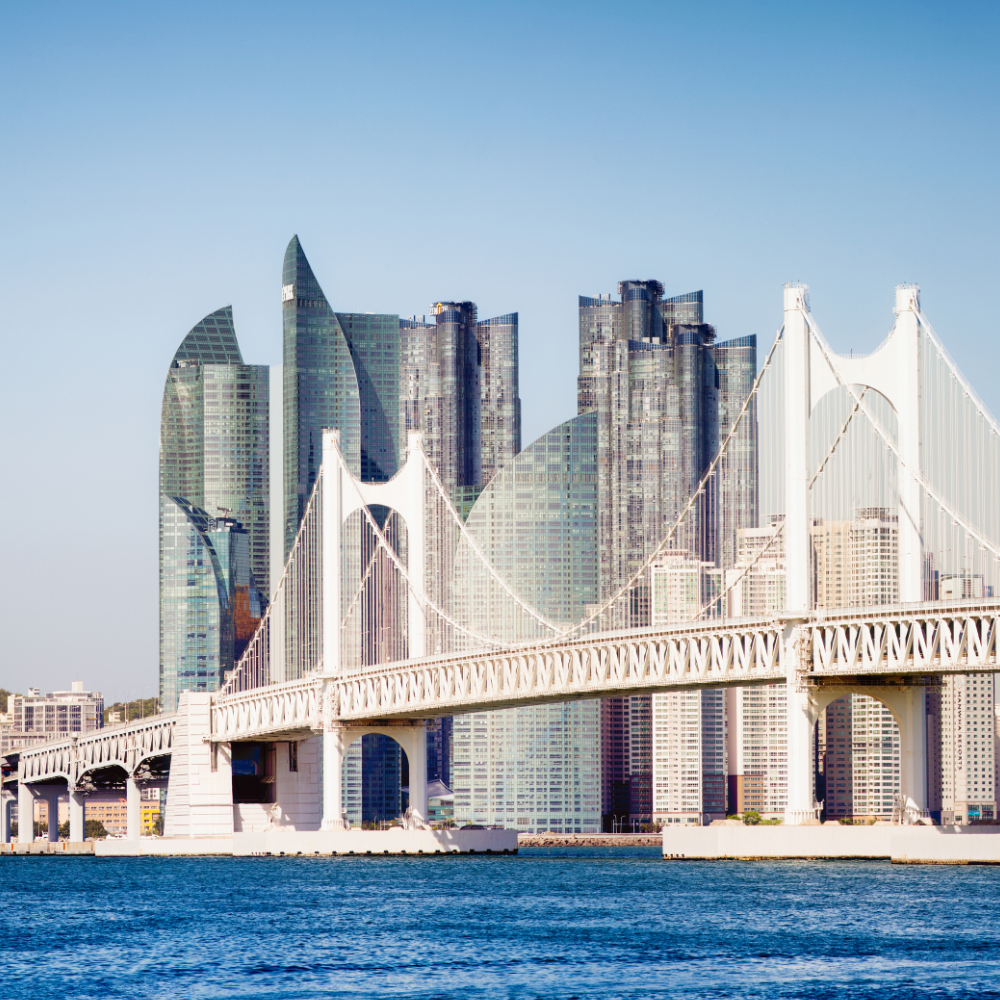
Gwangalli is the night beach. A curved bay aimed straight at the Gwangan Bridge, which turns into a light installation after dark, with a cafe-and-bar strip built entirely around that view. This is where Busan's evenings happen — chicken and beer on the sand, the bridge doing its colour cycles — and on many Saturday nights the sky itself performs: Gwangalli's recurring drone light shows have become one of the city's signature free spectacles. Check the current schedule locally, arrive early for sand space, and stay past full dark.
Day at Haeundae, sunset transfer, night at Gwangalli: fifteen minutes apart, and together they are the complete argument for the overnight stay.

Beyond the Big Two: Songjeong, Songdo and the Cliffs
The coast's depth is in its supporting cast.
Songjeong, one stop past the Blueline's end, is Korea's surf town in miniature: a mellower beach with year-round surf schools, board rental and the country's most established wave culture. Beginner lessons run through the warm months and wetsuited regulars keep going long after — the antidote if the big beaches feel produced.
Haedong Yonggungsa, up the coast beyond Songjeong, is the image on half of Busan's postcards: a 14th-century-rooted temple rebuilt on ocean rocks, waves breaking beneath the halls — one of very few seaside temples in a country whose temples usually live in mountains. It is genuinely spectacular and genuinely crowded; go before mid-morning.
Huinnyeoul Culture Village, on Yeongdo island across the harbour, is the quiet counterweight: a former refugee-era neighbourhood of white-walled lanes on a cliff above the shipping channel, now dotted with tiny cafes and studios. Film-famous, resident-inhabited — the usual living-village manners apply — and the coastal path below the cliff is one of the city's finest short walks.
Songdo, the west side's answer, stacks its attractions: Korea's oldest public beach, the cable cars running across the bay (glass-floored, for those who earn it), and the Yonggung suspension bridge to a tiny island. Less international, more local-weekend — which is its charm.

Timing, Eating and Getting There
Timing: late spring and early autumn — May, June, September, October — are the sweet spots: warm, clear, and free of the July–August crowds and monsoon humidity. Official swimming season runs the summer months with lifeguards, lockers and showers at the major beaches. Winter has its own austere appeal: sunrise walks with coffee, empty sand, and the year's clearest light on the bridge. One local rhythm worth copying: Busan does sunrise well — Haeundae's east-facing sweep fills with dawn walkers year-round.
Eating: the coast eats as well as it looks. Grilled eel and raw-fish rounds at Millak's waterfront raw fish centre by Gwangalli; dwaeji gukbap and market food downtown; and the full Jagalchi fish-market experience — choose downstairs, eat upstairs — covered properly in our regional markets guide. Beach chicken delivered to the sand at Gwangalli is not a tourist gimmick; it is the local Friday.
Getting there and around: the KTX runs Seoul to Busan in under three hours, and the coastal quarters are metro-reachable from the station — Haeundae and Gwangalli each sit minutes from their subway stops. Base yourself at whichever beach matches your evenings, use the metro and short taxis between coastal points, and give the city a night minimum. Day-tripping Busan from Seoul is possible and universally regretted.

Dr. Beau's Note
Walk one stretch of the coast instead of transiting all of it. The temptation in Busan is to taxi between highlights and collect them — temple, beach, bridge, done. The city's actual gift is the connective tissue: the clifftop path from Mipo to Cheongsapo with the sea on your right, or the walkway under Huinnyeoul's white lanes. Pick one, give it ninety unhurried minutes, and let the famous stops be the punctuation rather than the sentence. It is the difference between having seen Busan's coast and having been on it.