Korean Indie Music: Where to Start, and Where to Hear It
Korean indie is music made outside the big entertainment agencies, by artists who release on their own or through small independent labels; it is a way of working, not one genre. Start with wave to earth, The Poles or Say Sue Me if you like dreamy guitars, HYUKOH or Silica Gel for bands already touring the world, and Hanroro or Lee Seung-yoon for songwriters. To hear it live, go to the clubs of Hongdae, a summer festival such as Pentaport, or Jebi Dabang in Sangsu-dong, a cafe whose basement shows run on audience donations.

What "Korean Indie" Actually Means
In Korea, "indie" (인디) first describes who owns the music, not how it sounds. The people who built the scene define it as independence from big capital: the musician, or a small label, plans, records, releases and promotes the work without a major entertainment company behind it. Ko Gun-hyuk, who founded the label Boongaboonga (BGBG) Records, said in 2014 that indie has nothing to do with sales or being mainstream; what counts is independence from capital. When big companies began buying into indie labels in the mid-2010s, the critic Kim Yoon-ha said that a large company owning an indie label was a contradiction in terms.
Over the years the word has also come to mean a mood: guitar-based, a little introspective, made by people who write their own songs. That is why the two meanings don't always line up. DAY6 and Xdinary Heroes write and play their own music, but they come from JYP Entertainment's band division, Studio J. N.Flying is an FNC Entertainment band, LUCY is on Mystic Story, and QWER is a project band put together by the YouTuber Kim Gye-ran. All of them belong to the 2020s band wave, and none of them is indie in the structural sense. Writing your own songs doesn't make you independent; the company you release through does.
The singer-songwriter Colde is the best example of where the line sits. He started in the R&B duo offonoff in 2016, went solo in 2018 and in 2019 founded his own label, WAVY. In 2021 WAVY signed wave to earth as its first band, and The Poles joined in 2024. Colde reaches a mainstream audience, with collaborations with RM and tours of North America, Europe and Asia, yet his records still come out on the independent label he started. In August 2024 he stepped down as WAVY's chief executive to focus on his own music, and on August 14, 2026 he released the EP ICY BABY, a brighter, more energetic turn from his soft, airy R&B. Independent by structure, mainstream by reach: that combination is common in Korean indie today.

From a Hongdae Club to the Band Boom: A Short History
Korean rock had a scene around the universities of Sinchon in the 1980s, but rising rents in the early 1990s pushed musicians a few stops west, to the streets around Hongik University. In April 1995, on the first anniversary of Kurt Cobain's death, local musicians held a tribute show at Club Drug in Hongdae. That night is widely treated as the start of Korean indie, and Korea celebrated the scene's 30th anniversary in 2025 with festivals, exhibitions and free concerts. Crying Nut, No Brain, Deli Spice and Sister's Barber Shop led the first wave, and live music in bars was only legalized in 1999 after musicians lobbied for it.
The 2000s brought the labels. Pastel Music turned to indie in 2004, and Boongaboonga Records was founded in 2005 by friends at Seoul National University; together the two led indie's second golden age. In 2008 Kiha & The Faces' "Cheap Coffee" carried the scene out of the clubs and onto television. The 2010s produced the bands most overseas listeners know now: JANNABI (formed 2012), whose 2019 album Legend gave them a No. 1 single; Silica Gel (formed 2013); HYUKOH (formed 2014); and Se So Neon (formed 2016).
The pandemic shut the clubs, and what followed was the "band boom" of 2023 to 2025. Critics point to young audiences returning to festivals hungry for live music, to listeners looking for an alternative to idol pop, and to a wave of Japanese rock that spread through short-form video. The charts show it. DAY6's "Happy" spent 26 consecutive days at No. 1 on the Melon Top 100 in 2024, and Silica Gel's streams rose 164.5% after the band performed at the Melon Music Awards in December 2023, according to the Korea Times. Agency bands drove much of the chart story, but the audience they built now fills indie shows as well.
In 2026 the scene is busy. At the 23rd Korean Music Awards in February, Hanroro was named Musician of the Year and Album of the Year went to Chudahye Chajis's Sosuminjok. Chang Kiha, once the frontman of Kiha & The Faces, released his first solo studio album in September, and EBS brought back its free studio shows and its rookie contest after a pause of several years.

Where to Start, by Taste
The quickest way in is to start from something you already like. This guide is the hub of our Korean indie series, and each route below leads to a longer article with entry tracks for every artist.
If you like soft, dreamy guitars, start with wave to earth, a trio that mixes lo-fi indie rock with jazz drumming; our guide to wave to earth's album bad pieces covers their August 2026 record. Then try The Poles, WAVY labelmates with the same singer and producer, Daniel Kim, but a straighter rock backbeat and layered guitars. ADOY makes glossy, synth-led night-drive pop, and Say Sue Me, from Busan, plays surf-inspired indie rock with reverb-soaked guitars. Our list of bands like wave to earth has seven more names.
If you want acts that already have an audience abroad, start with HYUKOH: loose, jangly guitar pop on the early records, slower and hazier now. Silica Gel plays dense, shape-shifting guitar rock that locks into tight grooves and then opens into noisy psychedelia. Leenalchi sets pansori singing over two basses and drums, and Jambinai plays traditional Korean instruments with the weight of heavy rock. All of them are in our guide to Korean bands popular overseas. The Rose, who started out busking, are a story of their own; we explained what The Rose's ROSETOPIA tour and break mean separately.
If you follow songwriters more than bands, start with Hanroro's bright guitar pop and big sing-along choruses, Lee Seung-yoon's wordy, theatrical rock, and Car, the garden's husky band ballads. These artists came up through the independent scene and now release through mid-size companies, which is why our guide calls them Korean singer-songwriters with indie roots.
If you want to hear bands that still play the small rooms, start with jisokuryClub's sunny, groove-led "fishing pop," Kachisan's punchy guitar rock with theatrical storytelling, hathaw9y's clean-toned soft rock and city pop, and Bongjeingan's twisty, guitar-heavy alt-rock. They are all in our list of underground Korean bands worth knowing.
To go deeper and louder, try Parannoul, a Seoul musician who made walls of distorted shoegaze guitar in a bedroom and found an audience online. The 2021 album To See the Next Part of the Dream was reviewed by Pitchfork, Consequence and Stereogum; start with "Beautiful World."

How New Korean Bands Get Found
Without an agency's marketing budget, new acts rely on a handful of programs that critics, broadcasters and fans follow closely. If you want to find the next names yourself, these are the lists to watch.
EBS Space Gonggam is the public broadcaster's live-music program, with a studio stage running since 2004. Its rookie contest, Hello Rookie, began in 2007, and its alumni include Kiha & The Faces, Guckkasten, Jambinai, Silica Gel, Hanroro and jisokuryClub. The contest paused after 2022 and returned in 2026, funded by money Google gave EBS; 952 acts applied for the first monthly round. The 2026 final will be held on November 20 at Blue Square in Hannam-dong.
Melon Track Zero, launched in April 2022, is the indie program of the Korean streaming service Melon. An expert panel picks an artist of the month and a set of recommended new tracks, with playlists to match. The October 2026 pick was jisokuryClub, whose first album, Koh Larn, came out on September 27. CJ Cultural Foundation's Tune Up has supported independent musicians since 2010 with album funding and showcase stages; Se So Neon and Car, the garden are among its alumni, and its 2025 class was chosen from 791 applicants. The Korean Music Awards, held since 2004, are judged by critics, radio producers and academics, and sales don't count, so the winners lists are a good map of the independent scene.
Global brands are paying attention too. Fender Next, the guitar maker's program for new artists, named its class of 2026 on July 17: 15 artists from eight countries, with Redoor, a four-piece modern rock band that debuted in 2021, as the only Korean act. Their songs start intimate and swell into wide walls of guitar.

Jebi Dabang and the Rooms Where It Happens
Jebi Dabang: A Cafe Above, a Stage Below
If you visit one room to understand Seoul indie, make it Jebi Dabang (제비다방). It opened on April 17, 2012 in Sangsu-dong, a two-minute walk from exit 3 of Sangsu Station on Line 6, as a cultural space where different kinds of art could be shared. Its name is borrowed from Jebi, the tearoom the writer Yi Sang ran in Jongno in the 1930s, where the artists of his day met over coffee. The venue describes itself as part gallery, part stage and part playground for new culture, built on Lemon Salon, a space its team had run since 2005.
By day it is a cafe. At night it becomes Chwihan Jebi, the "Drunken Swallow," and a band plays downstairs. The building itself is the reason people remember it. There is a wide opening in the ground floor, so you can sit at a table upstairs and look straight down onto the small basement stage, which is framed by light bulbs and shelves of books. The venue says its weekly shows are funded by voluntary donations from the audience: you watch the set, then put what you think it was worth into the box.
Jebi Dabang is run by CTR, a culture studio on the floors above whose projects include the label CTR Sound, and since 2015 it has released compilation albums of bands that have played the room. It streams many of its shows on its own YouTube channel, JEBI ON AIR, whose archive goes back to a September 2015 clip of HYUKOH playing the room, a year after the band's first EP. In 2025 the Seoul city government named it Mapo-gu's pick for Seoul Edition 25, a list of local attractions chosen by experts and a public vote. To see who is playing, check the chalkboard by the red door or the venue's official channels.

The Other Rooms, and the Festivals
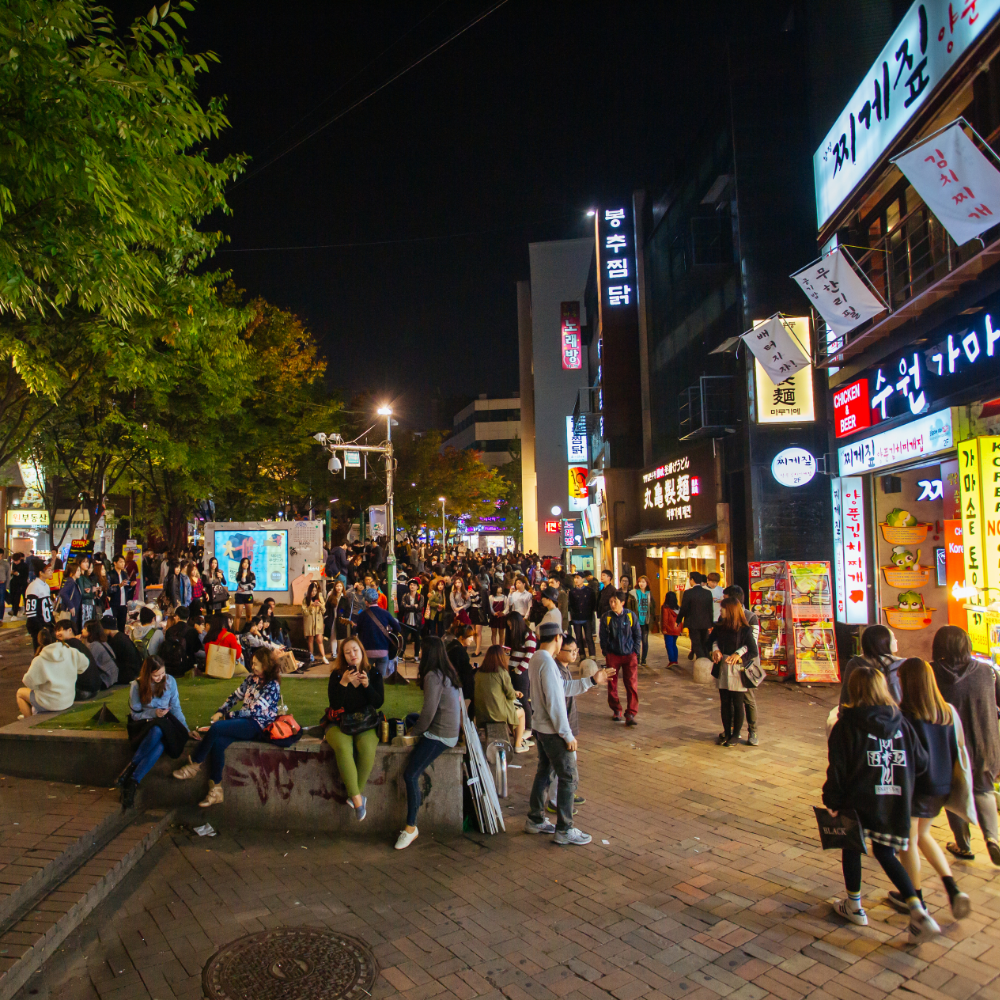
Many of Seoul's club shows happen a short walk from Jebi Dabang, around Hongdae, Sangsu and Hapjeong. Rolling Hall opened in Sinchon in 1995, moved to Hapjeong in 2005 and hosts at least 200 acts a year; DAY6 played its first show there. KT&G Sangsangmadang Hongdae has its own live hall, and Musinsa Garage, with room for 550 standing, hosted the Korean Music Awards in February 2026. Bigger tours play Hyundai Card Understage in Hannam-dong and YES24 Live Hall in Gwangjin-gu.
Festivals follow the seasons: Beautiful Mint Life in late May, Incheon Pentaport Rock Festival at the start of August, Zandari Festa across Hongdae's venues in early September, and Grand Mint Festival at Olympic Park in October. EBS Space Gonggam's free studio shows continue through November, with Silica Gel on November 5. For tickets, club etiquette and the last train home, read our practical guide to seeing Korean indie bands live in Seoul.
Korean Indie Abroad
Korean indie bands now tour far beyond Seoul. Japan is the closest stage. At FUJI ROCK FESTIVAL 2025, Silica Gel made its debut on a bill that also included Leenalchi, Balming Tiger and HYUKOH, and HYUKOH returned for FUJI ROCK '26, playing the Red Marquee stage on July 24. Silica Gel ends its current tour in Tokyo on November 21 at Spotify O-EAST in Shibuya.
Taiwan has a special link through HYUKOH. In July 2024 the band released AAA, a joint album with the Taiwanese band Sunset Rollercoaster, and the two toured it together, including shows in Seoul and Taipei; "Young Man" is the easiest song to start with. LUCY, an agency band, has also played repeated solo shows in Taipei, and can't be blue, a hook-first pop-rock band from the underground, has a European tour from November 2 to 10 and an encore show in Taipei on November 15.
Europe and North America have their own routes. The Korean Cultural Center in Germany held the fourth K-INDIE ON festival in Berlin on September 19 and 20, with Catch The Young, Bongjeingan, Kim Seung-joo and Chang Kiha. Leenalchi signed in 2026 with Luaka Bop, the American label founded by David Byrne, and Se So Neon toured North America in 2025. Redoor has played Taiwan, Germany and Japan, and wave to earth announced a North American tour with bad pieces.

Sori's Note
People ask me whether a band is "really" indie as if it were a test of taste. I'd ask a different question: who decided how the record sounds? An agency band can make a song you love, and an independent artist can make something forgettable. The label line matters because it tells you who carries the risk, not because it tells you what is good.
That is why Jebi Dabang matters to me. A show where the audience sets the price is the scene's definition of independence in its simplest form: the band plays, and you decide what it was worth.