
Doing Nothing, on Purpose: Korea's Art of Meong
Meong is the Korean habit of letting the mind go deliberately blank — bul-meong in front of a fire, mul-meong beside water, san-meong facing a mountain. It is not meditation and not laziness; it is an unstructured pause that Koreans schedule the way other people schedule exercise, and the country has built riverside parks, quiet cafes and even a national competition around it.

What Meong Actually Means
Ask a Korean friend what they did on Sunday and there is a fair chance the answer is meong ttaerigi — literally, hitting blank. Meong is the vacant, unfocused state your face falls into when nothing is being processed; ttaerida is the verb for striking something. Put together, the phrase describes a deliberate act rather than an accident. You do not drift into meong. You go and do it.
That grammatical detail matters more than it sounds. In most languages, the vocabulary for staring into space is faintly accusatory: daydreaming, zoning out, wasting time. Korean gives the same behaviour an active verb, a place to do it, and a socially acceptable slot in the week. Nobody apologises for it. Ask someone where they are going and "I'm off to do some mul-meong" is a complete answer.

What separates meong from meditation is the absence of technique. There is no posture, no breath count, no app, no teacher and no goal. There is no correct way to fail at it. You sit in front of something that moves slowly and holds the eye — water, flame, foliage — and you let attention go where it wants. Meditation asks you to notice your mind. Meong asks nothing at all, which is exactly why people who bounce off meditation tend to stay with it.
Bul-meong, Mul-meong, San-meong
The practice is named for whatever you point yourself at, and the compounds have quietly multiplied over the past decade.
Bul-meong (bul, fire) is the original and still the most beloved. It came out of the camping boom, where the last hour of the evening is spent doing nothing but watching a fire collapse into embers. It spread from campsites into ordinary living rooms around the mid-2010s, mostly through fireplace videos played full-screen on the television — a substitute so convincing that in 2023 The Korea Herald reported emergency calls from neighbours who had seen the flames through a window and assumed the worst.

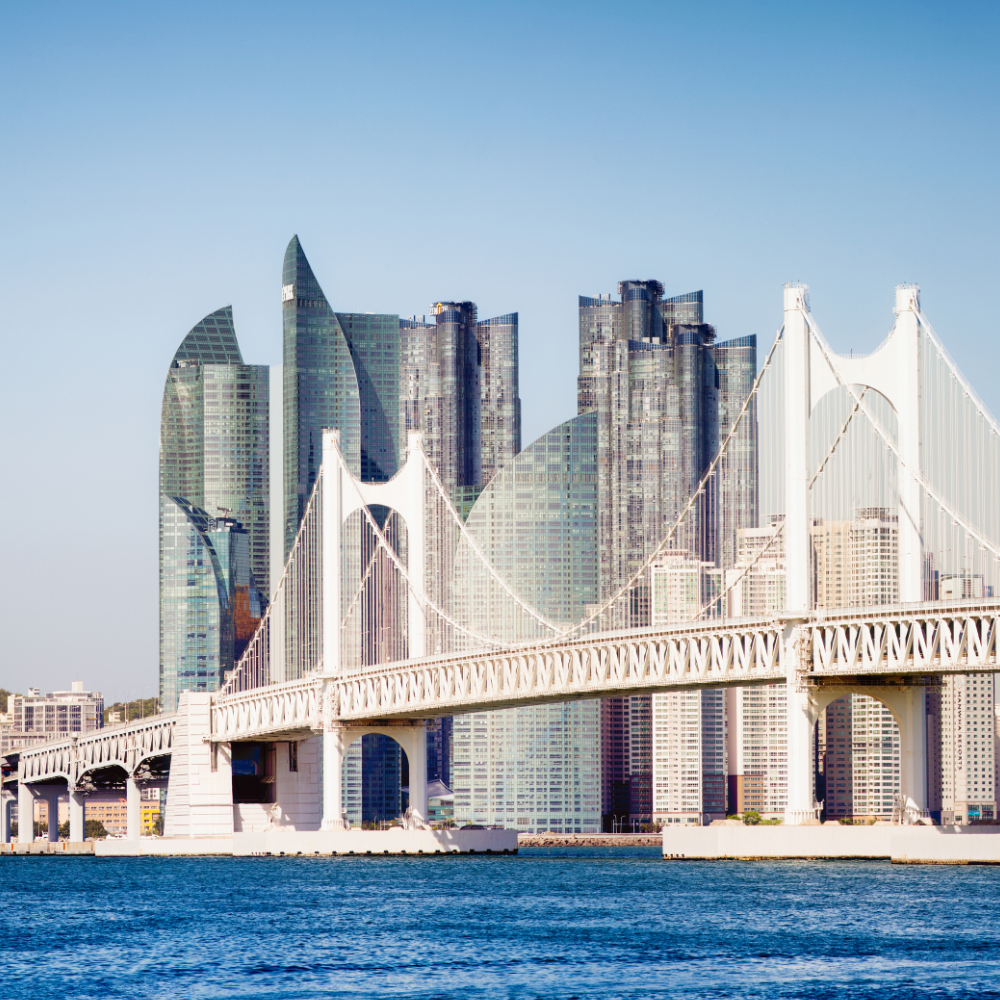
Mul-meong (mul, water) is the summer form, and the one visitors adopt fastest. Any moving water counts: the Han River from a park bench, the sea from a Busan cafe window, a stream in a valley, a waterfall in a city park. Water outperforms fire in one specific way — it never repeats, so the eye never finishes with it.
San-meong (san, mountain) is the version built into Korean geography. With ridgelines visible from most city streets and trailheads sitting at the end of subway lines, a green horizon is rarely more than an hour away. It overlaps with the country's enormous hiking culture, though san-meong specifically refers to the part where you stop climbing, sit on a rock, and look outward for a while.
Newer variants keep appearing — sup-meong for forests, bit-meong for rain. The pattern is productive, which is a linguist's way of saying the idea is alive rather than nostalgic.
The Competition Where Nobody Does Anything
The clearest proof that Korea takes this seriously is that it turned it into a contest. The Hangang Space-Out Competition has been held at Banpo Hangang Park in Seoul since 2014, and the format has barely changed: contestants sit on mats on the grass by the river and stay in a state of blankness for ninety minutes.

The rules are almost entirely negative. No phones, no talking, no laughing, no checking the time, no sleeping. Marshals move through the field to remove anyone who nods off, which is the detail people find funniest and most instructive: sleep disqualifies you, because sleep is not the same as rest while awake.
Scoring combines two things. Heart rate is measured through the session, and the most stable line takes the technical points. The audience then votes for the person who looked most convincingly, artistically vacant. The winner is crowned with a trophy shaped like Rodin's Thinker — a joke that lands better once you know the event was created by an artist responding to the idea that a busy-looking day is a well-spent one.
Winners are rarely who you would expect. The 2025 title went to the members of a punk rock band, which is roughly as surprising as it sounds. The competition normally runs in spring and applications open in advance through its official channels, so check the current announcement rather than assuming a date.
Where to Practise It in Korea
This is the part that has changed for visitors. The Korea Tourism Organization now treats everyday-life experiences as a core reason people come, and the Korea Times reported in early 2026 on a clear shift in what foreign travellers ask for — hiking, bathhouses and, specifically, water gazing, alongside the museums and palaces. With more than ten million international visitors arriving in the first half of 2026 alone, the quiet options have stopped being a secret and started being a plan.

The Han River parks. Eleven of them, all free, all open late, most within a short walk of a subway exit. Bring a mat. The stretch around Banpo and Ttukseom fills up in the evening, but the walking paths between parks stay quiet, and the reed beds along the water are the closest thing Seoul has to a wild edge.
Yongma Waterfall Park, Jungnang-gu. An old stone quarry in eastern Seoul that the city converted into a park in 1990, leaving the cut rock face standing and running water down it. The main fall drops 51.4 metres, which is roughly a twenty-storey building, and it is entirely artificial — a fact locals mention with obvious affection. The water does not run continuously; it is switched on for set periods around midday and early afternoon, with an extra evening session added during the hottest weeks of summer. Schedules shift by season, so confirm the current times with the district office before you travel across the city for it.
Cafes built for it. An entire category of Korean cafe exists to sell you a window and a long sit — mountain views in Gapyeong, sea views along the Busan coast, forest views an hour outside any major city. Nobody will hurry you out. Seoul's healing cafes are the indoor, year-round version of the same instinct, and they are where the practice moves when the weather turns.
A temple, if you want the deep end. A templestay is not meong — it has a schedule, a form and a teacher, all the things meong deliberately lacks. But the long unprogrammed stretches between sessions, sitting on a wooden veranda facing a mountain, are the purest san-meong most people will ever manage.
How to Actually Space Out
It is harder than it reads, and the difficulty is almost entirely about the phone. Everything else takes care of itself.

Put the phone down, not away. Burying it in a bag creates a low background anxiety about missing something. Set it on the bench beside you with the screen dark instead — within arm's reach but out of your hand, which removes the pull without removing the reassurance.
Choose something that moves and does not repeat. Water, fire, leaves in wind, clouds. Anything with a loop — a screen, a passing crowd, traffic — will pull you into pattern-recognition, which is the opposite of the point.
Give it longer than feels reasonable. The first ten minutes are usually restless and slightly boring. The competition's ninety-minute format is not arbitrary; the settling happens somewhere in the second half. Twenty to thirty minutes is a fair starting target.
Do not audit yourself. The moment you start checking whether it is working, you are doing something else. Thoughts arriving is fine. Chasing them is fine too. There is no version of this you can do badly.
Go with someone, in silence. Koreans often do this in pairs or small groups without speaking, which sounds awkward and turns out to be the easiest form. Company removes the self-consciousness of sitting alone doing nothing in public.
Dr. Beau's Note
When someone tells me their skin has looked tired for months, I get a full account of the products, the water temperature, the new serum, the clinic schedule. What I almost never get told is how the person has been sleeping, or whether there has been a single unstructured hour in the week. It is the one variable nobody thinks to report, and it is usually the one that changed first.
I am not going to claim a riverbank fixes anything measurable. But of all the wellness habits Korea exports, this is the one with no product attached, no cost and no way to do it wrong — which makes it the only one I never hesitate to recommend. If a skin concern is persistent, get it looked at properly rather than resting it away.