
Personalized Skin Clinic in Hongdae: How a Treatment Plan Is Built Around Your Skin
Pigmentation, uneven tone, pores and texture show up differently on every face, so a personalized plan begins with a skin assessment. Here is how that assessment shapes the plan, how laser toning settings and intervals are adjusted for each person, and how the plan can fit around your days in Seoul.

Key Summary
A personalized skin treatment plan starts from an assessment of your own skin, because pigmentation, uneven tone, enlarged pores and rough texture each have different causes and sit at different depths. For pigmentation and uneven tone, picosecond laser toning is planned as a series, with the energy, the number of passes and the spacing between sessions adjusted to how your skin responds.
You open the camera on your phone in the soft light of a Hongdae cafe and notice things you usually miss. A shadow of brown across one cheekbone, a tone that looks patchy around the mouth, pores that seem larger on the nose than they did a year ago. A friend with similar skin mentions the toning sessions she had in Seoul, and you start to wonder whether the same plan would work for you.
It may not, and that is the point of a personalized skin clinic in Hongdae. The same concern can have a different cause on your face, and the same device can be set in very different ways. This guide explains how a plan is built around that difference.
Why Do Pigmentation, Uneven Tone, Pores and Texture Look So Different From One Face to the Next?
Each concern has its own cause, and the causes combine differently in every person. Hyperpigmentation happens when pigment cells produce more melanin in one area than in the skin around it. Years of ultraviolet light, hormonal shifts and marks left after inflammation can all trigger it, and brown marks that look alike can sit at different depths in the skin. A sun spot usually sits in the outer layer with a clear edge, while melasma spreads in softer patches, often on both cheeks, and tends to react to heat and hormones.
Uneven tone is often a mix of faint pigment, light redness and dull texture, so two people who both call their skin uneven can need quite different plans. When an accurate diagnosis is needed, it is best to talk with our medical team first.

Pores and texture follow another pattern. A pore looks larger when the oil gland beneath it is active and when the skin around its opening loses some of its firmness. Rough texture can come from a thickened outer layer, shallow marks after breakouts or depressed acne scars in the dermis, and each responds to a different kind of energy.
How Does a Skin Assessment Shape a Personalized Skin Clinic Plan in Hongdae?
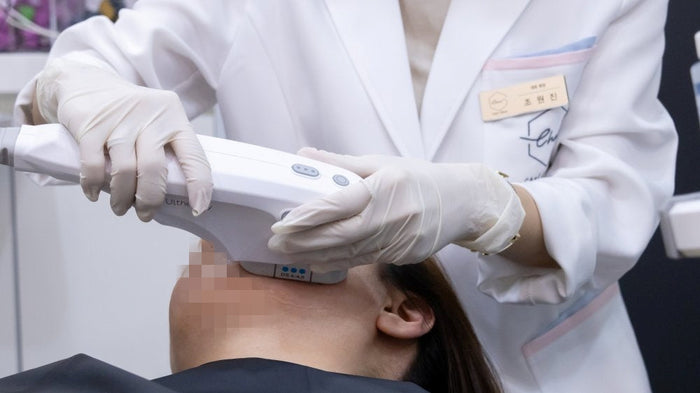
The next question is how a doctor tells these causes apart on your face. A skin analysis device records the skin under controlled light, so pigment, redness and pores that are hard to judge in a mirror can be compared area by area, and the doctor reads that record alongside your skin type and past reactions. The assessment settles which concern matters most, where it sits and how your skin is likely to respond to energy, and those answers decide the type of treatment and then the device.
This table is meant to help you follow a plan, not to rank the options.
| Concern | What the assessment looks for | Treatment types used |
|---|---|---|
| Spots and uneven tone | Type of pigment, its depth, and how easily the skin darkens after irritation | Pigment lasers (picosecond laser, Clarity II, LAVIEEN) |
| Enlarged pores and rough texture | Oil activity, firmness around the pores, thickness of the outer layer | Microneedle radiofrequency (Potenza) |
| Depressed acne scars | Shape and depth of each scar, and how firmly it is tethered underneath | Microneedle radiofrequency (Potenza), Trifill Pro |
Clarity II uses separate 755 nm alexandrite and 1064 nm Nd:YAG lasers for pigment or visible vessels, and LAVIEEN, a 1927 nm thulium laser, acts on surface pigment and tone. Potenza releases radiofrequency through fine needles with depth, intensity and spacing adjusted by area, while Trifill Pro uses pressurized medical-grade carbon dioxide to open small spaces beneath a depressed scar and deliver medication.

Dai et al. (2023) compared a fractional picosecond laser with an ablative fractional erbium laser for mild to moderate atrophic acne scars in 31 Asian adults, one method on each side of the face. Scar improvement rated by physicians was similar on both sides, and the authors concluded that the picosecond approach gave comparable results with a more favorable safety profile, although this was a small pilot study. For anyone planning texture treatment, the useful point is that methods with a similar aim can differ in recovery and in how the skin reacts, so your usual recovery belongs in the plan.
How Is a Laser Toning Plan Adjusted for Pigmentation and Uneven Tone?
Laser toning is adjusted by changing how much energy is delivered, how the handpiece covers the face and how much time passes between sessions. A picosecond laser fires pulses measured in trillionths of a second, so the pigment breaks into fine particles while less heat spreads into the surrounding skin. In toning, the laser is passed evenly over an area at a gentle setting, aiming at scattered pigment and dull tone rather than a single defined spot, and the body clears the broken pigment over the following weeks.

Because the change builds gradually, toning is planned as a series, not a single visit. The energy, the number of passes and the interval between sessions are set for each person and revisited at every visit. Skin with defined sun spots and little sensitivity can be treated more directly, while patchy tone that darkens easily after heat, as melasma often does, is approached with lower settings and more patience. The cheekbones, the mouth area and the forehead can each be set differently within one session. Our medical team plans these adjustments with care and keeps reviewing current research so that each step stays matched to how your skin is behaving at that visit.

Kim et al. (2020) treated sun spots on each side of the face in 20 people, one side with a picosecond laser and the other with a Q-switched laser, after a single session followed for 12 weeks. Both lasers lightened the spots and the picosecond side showed greater clearance, while darkening after inflammation appeared on 5 percent of the picosecond side and 30 percent of the Q-switched side. As a small study under fixed conditions, it does not predict any one person's outcome. What it does show is that the way energy is delivered affects how the skin reacts, which is why the tendency of your skin to darken after irritation is checked before the settings are chosen.
A Typical Case
A story we often hear begins after a summer of beach trips, when the tone across the cheeks starts to look blotchy and a brightening serum is added to the evening routine. The thought at that stage is usually, 'It will even out once the tan fades.' When the skin is assessed while the change is recent, the pigment tends to be shallow and limited to a few areas, so the toning plan can stay focused and the settings can be chosen with some room to spare. When the same patchiness is left through several more summers, faint sun spots often sit alongside softer patches that react to heat, and separating the two takes more care. The plan then covers more of the face, the settings stay more conservative and the series stretches over a longer period, which is harder to arrange from abroad.
How Can a Treatment Plan Fit Around Your Days in Seoul?
A plan made for a visitor has to fit the calendar as well as the skin. Telling the doctor your travel dates at consultation lets the order of treatments match your stay. A short stay usually means one concern and time for the skin to settle before you fly. If you visit Seoul more than once a year, a toning series can be spread across trips, and treatments that need more recovery, such as those for depressed scars, fit better early in a longer stay.

Daily habits matter too. A broad-spectrum sunscreen reapplied through long days outdoors helps protect skin in the middle of a pigment plan, and the doctor explains what to apply and avoid after each session.
What Should You Ask Before a Skin Clinic in Hongdae Sets Your Plan?
Clinics around Hongdae and Hapjeong can name similar devices, so a few questions say more about how closely a plan will follow your skin.
✓Will my skin be measured before the energy and intervals are decided? A record of pigment and pores gives the plan a fixed starting point for later visits.
✓Is the doctor who examines my skin the same person who treats it? Then details such as a cheek that darkens easily carry into every pass.
✓Will the plan begin with what my skin needs now? Starting with the main concern, not a bundle of treatments, shows how your skin responds before anything is added.
It is also reasonable to ask how the plan will change if your skin reacts more strongly than expected. A clear answer to that question tells you the plan is meant to move with your skin, not to run on a fixed schedule.

Seeing Each Face as Its Own Portrait

No two faces I draw ask for the same pencil. One portrait needs a light hand on the cheek, another needs deeper tones under the cheekbone, and the likeness depends on noticing those small differences before the lines go down.
Drawing faces in pencil has been part of my life since the pandemic years, and it has changed how I read skin. Tone across a face is never flat. It shifts gently from the forehead to the jaw, and that shift is part of who a person is.
When I plan laser toning, I look for where the tone breaks unevenly and where it simply follows the natural shape of the face. Some areas need patience and a lighter setting, others can be treated more directly, and I set each one so that the face still looks like you, with a clearer tone.
- Dr. Wonjin Jo, Director, Chai Clinic -
About Chai Clinic
Chai Clinic is in Hapjeong-dong, Mapo-gu, a short walk from Hongdae, and it has been 10 years since the clinic opened. Before each consultation, the skin is measured with MarkVu, and every plan is designed around the individual face, its proportions and its balance. The clinic uses genuine products in correct amounts and does not put together treatment packages on an opening visit, recommending what your skin needs at that point. You can arrange a consultation through Chai Clinic on BeautiPin.
It can be discouraging to try product after product and still see the same patch of tone in every photo. Whatever you choose during your time in Seoul, we hope you come away understanding your skin a little better and feeling more at ease with the face you see.
References
Dai R, et al. Comparison of 1064-nm Nd:YAG picosecond laser using fractional micro-lens array vs. ablative fractional 2940-nm Er:YAG laser for the treatment of atrophic acne scar in Asians: a 20-week prospective, randomized, split-face, controlled pilot study. Front Med (Lausanne). 2023;10:1248831. doi:10.3389/fmed.2023.1248831
A small split-face pilot study comparing two fractional laser methods for atrophic acne scars in Asian adults.
Cited in the section on skin assessment.
Kim JY, et al. A Split-Face, Single-Blinded, Randomized Controlled Comparison of 532 nm Picosecond Neodymium-Doped Yttrium Aluminum Garnet Laser versus 532 nm Q-Switched Neodymium-Doped Yttrium Aluminum Garnet Laser in the Treatment of Solar Lentigines. Ann Dermatol. 2020;32(1):8-13. doi:10.5021/ad.2020.32.1.8
A split-face study comparing picosecond and Q-switched lasers for sun spots over 12 weeks.
Cited in the section on laser toning.
That's all from Chai Clinic. Thank you for reading.